Insurance Claim Evidence Transport, Storage & Delivery
When a failed part or a burned appliance could decide who pays for a loss, how it gets from the scene to the lab matters. We handle insurance evidence transport for claims departments, forensic labs, subrogation teams, forensic engineering firms, independent adjusters, law firms and evidence storage facilities. Every item is photographed and inventoried at pickup, moved without unauthorized handling, and signed for with photos at delivery, so the chain of custody holds up when someone asks about it later.
- Call-ahead pickup
- Nationwide coverage
- 24/7 dispatch
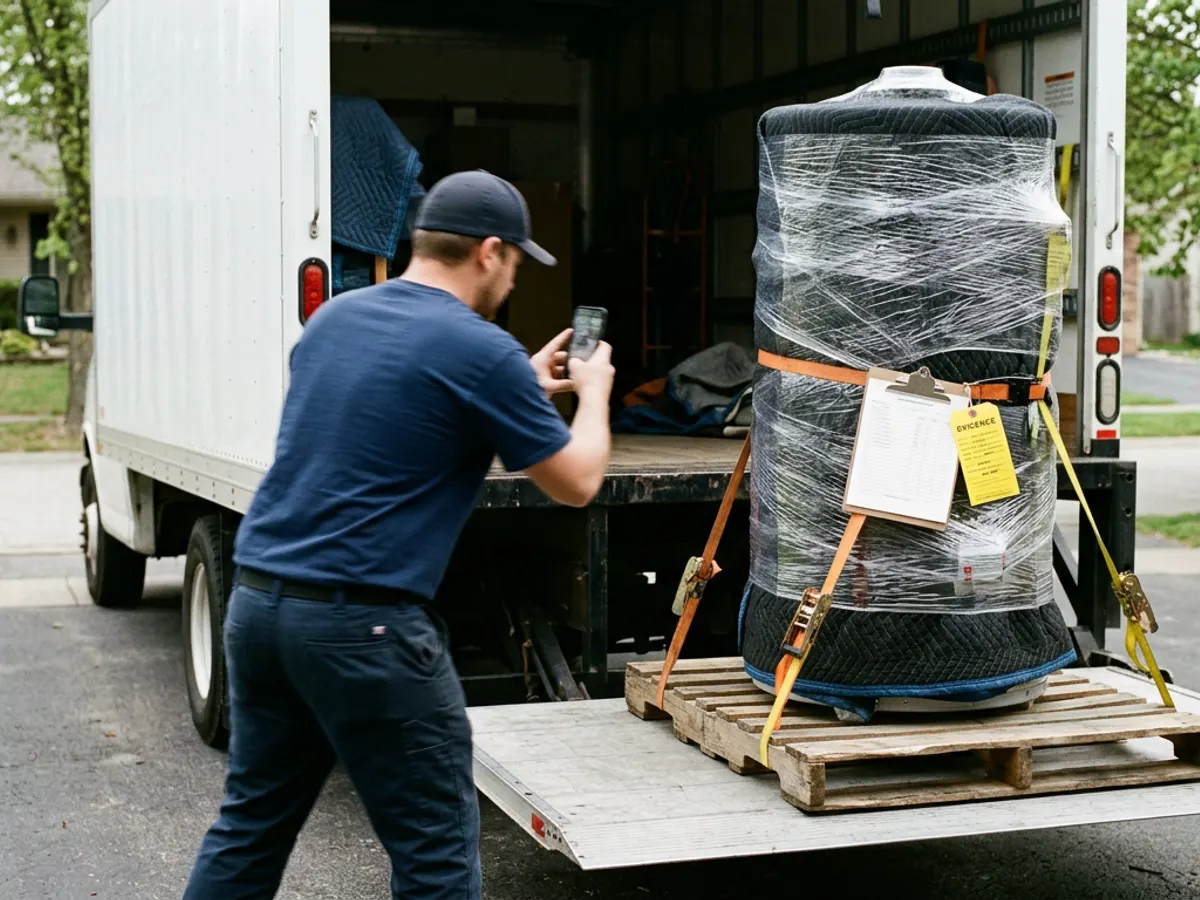
What we move: claim evidence too big for parcel
Most claim evidence is awkward: heavy, oddly shaped, sometimes still wet or covered in soot, and almost always too big or too fragile for a parcel carrier. Failed equipment evidence shipping is the bulk of our work, and it is the kind of freight our two-person crews and liftgate trucks are built for. We regularly pick up and deliver:
- Vehicle parts and transmissions from auto claims and product failures
- Engines, whole or partially disassembled at the direction of the examiner
- Appliances, including refrigerators, washers, dryers and dishwashers held for cause-and-origin review
- HVAC units, condensers and air handlers
- Water heaters and the supply lines and fittings that came with them
- Electrical panels, breakers, outlets and wiring sections
- Fire scene artifacts collected by origin-and-cause investigators
- Failed machinery components from commercial and industrial losses
- Pallets of evidence from a single scene or a multi-party exam
- Whole items too big for parcel, from a recliner to a commercial fryer
For fire and auto claim evidence, we keep each item with its tags, bags and labels exactly as the investigator left them. If you need something packed or crated before it moves, tell us and we will plan for it.
Who we work with
Our evidence clients include insurance carriers and their claims and forensic labs, subrogation departments, forensic engineering firms working fire, auto and product or equipment failure cases, independent adjusters, law firms on both sides of a claim, and evidence storage facilities that need a reliable carrier for incoming and outgoing items.
If you already have a chain of custody form, we will use yours. If not, ours covers what most labs and attorneys ask for.
- Insurance carriers and claims departmentsDesk and field adjusters who need an item moved from an insured’s home or business to the carrier’s lab or evidence warehouse without chasing a parcel claim.
- Subrogation unitsTeams preserving a failed product or component for recovery against a manufacturer, installer or another carrier, often for months while the file develops.
- Forensic engineering firmsMechanical, electrical and materials engineers who need artifacts delivered to the lab intact, then moved again for joint exams or returns.
- Fire origin and cause investigatorsInvestigators who have tagged and bagged artifacts at a scene and need them collected exactly as they were left, with nothing cleaned or rearranged.
- Independent adjusters and TPAsAdjusters and third-party administrators working on behalf of a carrier who want one call to handle pickup, storage and paperwork.
- Defense and subrogation law firmsAttorneys and paralegals who need evidence moved, held or produced for inspection with records that will hold up in discovery.
- Evidence storage facilities and labsFacilities that need a dependable carrier for inbound items from scenes and outbound items going to other labs, claimants or disposal.
- Product manufacturers doing failure reviewsManufacturers and their quality or legal teams retrieving failed units from the field for engineering review or a recall investigation.
Loss types we handle: fire, water, auto and equipment failure evidence
The item and the loss decide how we pack and move it. These are the claims we see most often, and what usually matters for each one.
Fire and explosion losses
Burned appliances, outlets, panels, space heaters, lithium battery devices and other artifacts collected by an origin-and-cause investigator. Fire debris is fragile and easy to disturb, so we keep debris bags, tags and containers together and move them upright and wrapped, without brushing anything off.
Water losses
Failed supply lines, water heaters, valves, fittings, toilet connectors, ice maker lines and the cabinets or flooring sections around them. We keep fittings attached the way they were removed and bag small parts so threads and fracture surfaces are not damaged in transit.
Auto and truck losses
Transmissions, engines, ECMs and other control modules, tires, wheel assemblies, brake components and steering parts pulled from vehicles at tow yards, body shops and dealerships. Heavy components are palletized and strapped; electronics are boxed and kept dry.
Appliance and electrical failures
Refrigerators, dishwashers, dryers, microwaves, electrical panels, breakers, surge protectors and wiring sections. Items are moved as found, with doors taped only if you approve it and cords left in place.
HVAC and mechanical failures
Condensers, air handlers, furnaces, compressors, pumps, motors and the controls that came with them. Many of these come out of attics, crawl spaces or mechanical rooms, and our crews are equipped to remove them carefully.
Product liability claims
Furniture, exercise equipment, ladders, tools and consumer products held for a defect review. These often need to be stored for a long time and moved more than once, so documentation at each handoff is important.
Cargo and theft claims
Damaged shipments, recovered stolen goods and pallets that need to be inspected, counted and held. We can pick up from a consignee dock or a police release location and deliver to the carrier’s inspection site.
Hail and wind roofing samples
Shingle, tile, metal and membrane samples, gutters and siding sections cut for testing. Samples are labeled by location on the roof and packed flat so impact marks are not confused with transit damage.
Large and bulky evidence
Whole vehicle components, generators, boilers, commercial kitchen equipment and machinery that will not fit through a parcel network. We plan the truck, liftgate, pallet jack or crating needed before the crew arrives.
Chain of custody shipping, step by step
Chain of custody shipping only works if each handoff is written down and nobody touches the item who should not. This is the process we follow on every evidence move:
- Documented pickup at origin. The driver photographs each item in place and after loading, and records it on a written inventory with your claim or file number, tag numbers and condition notes. The person releasing the item signs the pickup record.
- Sealed, blanket-wrapped and palletized handling. Items are wrapped in moving blankets, sealed or bagged as directed, and strapped or palletized so they do not shift. Evidence stays separate from other freight on the truck.
- Tracked through our network. The shipment moves on our own trucks with our own drivers, and you get a single point of contact who can tell you where it is at any point between pickup and delivery.
- Signed proof of delivery with photos. The receiving lab, facility or attorney signs for each item, and we photograph it at delivery. You get the pickup record, the photos and the signed delivery receipt together.
- No unauthorized handling or disassembly. We do not open, clean, test, repair or take apart evidence. If something needs to change, it happens only with written direction from the party that hired us.
How a nationwide evidence pickup works
Here is what happens between the moment you send an assignment and the moment the paperwork lands in your inbox.
- Assignment received. You send the claim or file number, the pickup address and contact, a description of the items, the destination and any deadline. We confirm we have it and ask about anything missing.
- We call the claimant or site contact. We reach out to the homeowner, shop manager, tow yard or facility to explain who we are, what we are picking up and what access we need, so your adjuster does not have to coordinate it.
- Scheduled call-ahead pickup. We set a pickup window that works for the site, then call ahead on the day so the contact knows when the crew is close.
- On-site photos, item count, condition notes and labels. Before anything is moved, the crew photographs the items where they sit, counts them against the assignment, notes visible condition and applies labels with your claim number.
- Wrapping, crating or palletizing. Each item is blanket wrapped, stretch wrapped, palletized or crated depending on what it is and what you asked for, then loaded and secured.
- Tracked in transit. The shipment stays on our trucks with our drivers. You can call or email your contact at any point for a status update.
- Delivery to the lab with photos and signed POD. The receiving lab or facility checks the items in, signs the proof of delivery and we photograph each piece at delivery.
- Paperwork emailed to the adjuster. The pickup record, photos, inventory, bill of lading and signed POD are sent to the adjuster or whoever you name on the assignment.
Packaging and handling for forensic evidence transport
Good packaging protects the item and protects the record. The goal is that whatever the engineer finds at the lab is what was there at the scene, not something the trip caused.
- Blanket wrap for appliances, cabinets, furniture and anything with a finish or a surface that matters
- Stretch wrap over blankets to hold doors, panels and loose parts in place
- Corner boards and edge protection on boxed or palletized items so straps do not crush or mark them
- Palletizing for heavy or multi-piece evidence so it can be moved with a pallet jack or forklift instead of by hand
- Crating on request for fragile, high-value or oddly shaped items, or when a lab asks for it
- Debris bags, small parts and fasteners kept with the item they came from, labeled and never mixed with other evidence
- No cleaning, draining, disassembly or repair. If an item is wet, sooty or leaking, we contain it and tell you, rather than fixing it
Evidence transport and storage services
Pickup from claimant homes, shops and scenes
Nationwide evidence pickup from residences, repair shops, tow yards, dealerships, warehouses and loss sites. We call ahead to set a time with the homeowner or site contact, so your adjuster does not have to.
Delivery to forensic labs and insurer evidence facilities
Forensic evidence transport to engineering labs, testing facilities and carrier evidence warehouses, with the appointment booked and the receiving dock or room confirmed ahead of time.
Secure evidence storage in Richmond, VA
Our Richmond, VA warehouse works as an evidence storage facility for items that need to be held while a claim or lawsuit plays out. Pallet storage is available short or long term, labeled by claim, and released only on your instruction. Subrogation evidence storage often runs for months or years, and we keep it intact for as long as you need.
Returns to the lab or the claimant
Evidence return to lab for a second exam, a joint exam with other parties, or back to the claimant once the file closes, with the same photos and signatures at each step.
Disposal coordination
When the carrier authorizes it in writing, we haul items away and coordinate disposal or recycling, and send you documentation that it was done.
Inside pickup, liftgate, residential and commercial
Our crews go into basements, garages, utility rooms and mechanical spaces to remove items, and every truck can use a liftgate for locations without a dock. We handle both residential and commercial addresses.
Evidence storage facility in Richmond, Virginia
Not every item goes straight from the scene to a lab. Some need to sit while parties are notified, while a suit is filed or while a joint exam is arranged. Our Richmond, Virginia warehouse gives you a place to hold that evidence with the same documentation as the move itself.
Secured warehouse
Evidence is kept inside our warehouse, not in a trailer or an outdoor yard. Access is limited to our staff, and items are not moved around the building without a reason.
Pallet storage, short and long term
Items are stored on pallets, labeled with the claim or file number and photographed when they come in. Storage can run a few days or several years, depending on the file.
Joint inspection scheduling
When several parties need to see the evidence, we can stage it for a joint exam at our warehouse or deliver it to an agreed lab, and coordinate the date with the parties you name.
Release only on written authorization
Nothing leaves storage without written authorization from the party that placed it with us. Phone requests are confirmed in writing before anything moves.
Later return or disposal
When the claim or case is resolved, we return items to the claimant, ship them to another facility, or dispose of them once the carrier authorizes it, and send you records of the final step.
Documentation you get with every evidence move
The paperwork is half the job. Every evidence shipment comes with a set of records you can add to the claim file or hand to counsel:
- Pickup photos showing each item in place and after loading
- An inventory list with your claim or file number, item count, tag numbers and condition notes
- A bill of lading for the shipment
- Delivery photos showing each item at the receiving lab or facility
- A signed proof of delivery from the person who accepted the items
- Storage receipts with intake dates, photos and pallet locations when evidence is held in our warehouse
Records are emailed to the adjuster or contact named on the assignment, and we keep copies so they can be re-sent if a file changes hands.
Coverage: nationwide evidence pickup with fast local service
We pick up and deliver evidence across the continental United States, from single items to multi-pallet loads. Long-distance moves run on our own trucks rather than being handed to a parcel network. Closer to home, we can usually move faster:
Richmond, Virginia
Our warehouse and home base. Pickups across Richmond, Henrico, Chesterfield and Hanover are often scheduled the same or next day, and evidence can go straight into storage without an extra leg.
Virginia Beach and Hampton Roads
Regular service to Virginia Beach, Norfolk, Chesapeake, Newport News and Hampton for residential losses, marine and auto claims, and commercial equipment failures.
Fredericksburg
Fredericksburg, Stafford and Spotsylvania sit between our Richmond base and Northern Virginia, so pickups there fit easily into routes running in either direction.
Northern Virginia
Fairfax, Loudoun, Prince William, Arlington and Alexandria, including townhomes and condo buildings where parking, elevators and building rules need to be arranged ahead of time.
Washington, DC
Residential and commercial pickups across the District, with loading zones, building access and certificate of insurance requests handled before the crew arrives.
Baltimore and Maryland
Baltimore city and county, Montgomery and Prince George’s counties, Annapolis and the rest of Maryland, for both scene pickups and deliveries to labs in the region.
Returns, lab-to-lab shipping and disposal
Evidence often moves more than once. When the exam is done, the item still needs to go somewhere, and that move deserves the same records as the first one.
Returning evidence to the claimant
Once the carrier releases an item, we deliver it back to the claimant’s home or business, carry it inside if needed, and get a signature and photos at delivery.
Lab-to-lab shipping
Evidence return to lab, transfers between labs for a second opinion, and moves to an opposing party’s expert, with the chain of custody continued on the same records.
Holding for litigation
If a file goes into suit, we can hold evidence in our Richmond warehouse until the case is resolved and produce it for inspection when the parties are ready.
Disposal only with carrier authorization
We dispose of or recycle evidence only after the carrier, or the party that owns the file, authorizes it in writing. You receive photos and a record that the disposal was completed.
Why claims teams use us for claim evidence shipping
- We are an asset-based carrier, so your evidence moves on our trucks with our drivers rather than being brokered to whoever is available
- Every driver and helper is background-checked and drug-screened
- Photos and a written inventory at pickup and again at delivery
- One point of contact from the first call until the item is delivered, stored or disposed of
- Dispatch 24 hours a day, 7 days a week, including weekends after a loss
- Nationwide coverage, plus local service across Richmond and Virginia, Washington DC, Maryland and Northern Virginia
Claim evidence shipping is usually a small part of a big file. Our job is to make it the part you do not have to think about, and to give you clean records if anyone questions it.
Frequently asked questions
How do you keep chain of custody?
Each item is photographed and listed on a written inventory at pickup, and the person releasing it signs the record. It is wrapped and secured, kept separate from other freight, and carried on our own trucks. At delivery the recipient signs for each item and we photograph it again. Nobody opens, tests or disassembles evidence without written direction from you.
Can you pick up evidence from a homeowner?
Yes. We call the homeowner ahead of time to schedule a pickup window, send a two-person crew, and remove the item from wherever it is, including basements, garages and utility rooms. The homeowner signs the pickup record and you get the photos.
Do you store evidence?
Yes. We store evidence in our Richmond, VA warehouse on pallets, labeled by claim or file number, for short or long term. Items are released only on your written authorization.
Can you return evidence to the claimant or dispose of it?
Yes. Once the file closes, we can return items to the claimant, send them back to a lab, or haul them away for disposal when the carrier authorizes it in writing. Each option comes with photos and signed paperwork.
How fast can you pick up?
Dispatch is available 24/7. In Richmond, Virginia, Washington DC, Maryland and Northern Virginia we can often pick up the same or next day. Elsewhere in the country, timing depends on the location, and we will give you a pickup date when you call.
Do you ship nationwide?
Yes. We pick up and deliver evidence anywhere in the continental United States, with local service across Virginia, DC and Maryland.
Do you open or test evidence?
No. We do not open, clean, drain, test, repair or disassemble evidence. We move it as it was released to us. If an item needs to be changed in any way before it moves, that happens only with written direction from the party that hired us.
What if the item is heavy or large?
That is most of what we move. We send a two-person crew, a liftgate truck and a pallet jack, and we can palletize or crate the item on site. For very heavy items like engines, boilers or machinery, tell us the approximate size and weight so we can plan the right equipment.
Can you meet an engineer on site for a joint exam?
Yes. We can schedule the pickup to follow an on-site exam, wait while the engineer or investigator finishes, and remove the items they release. We can also stage stored evidence at our Richmond warehouse for a joint inspection.
Do you handle evidence for law firms?
Yes. We work with defense and subrogation law firms to move, hold and produce evidence, and we can send records to the attorney, the carrier or both.
What info do you need to schedule a pickup?
The claim or file number, the pickup address with a contact name and phone number, a description of the items with approximate size and weight, the destination lab or facility, and any deadline. Photos help but are not required.
What does it cost?
Cost depends on the pickup and delivery locations, the size and weight of the items, whether inside pickup or crating is needed, and how long storage runs. Send the addresses, a short description and photos if you have them, or call 866-216-7742, and we will quote it.
Need evidence picked up, stored or delivered to a lab?
Call 866-216-7742, any time, or send us the assignment and we will confirm a pickup plan.
Send us the assignment
- Claim or file number
- Pickup address and site contact
- Item description and approximate size
- Destination lab or facility
- Deadline or exam date