What Is Last Mile Delivery? How It Works and Why It Costs the Most
Published by Professional Moving Solutions
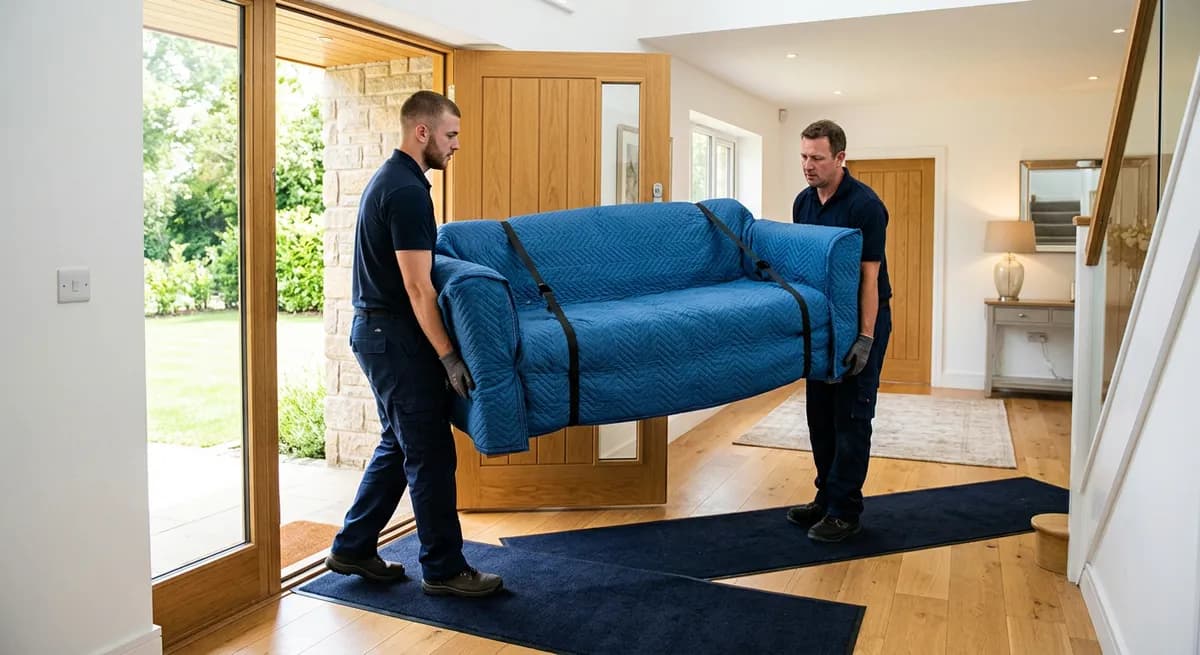
Every shipment ends the same way: someone has to get the item from a truck to the person who ordered it. That last stretch is called the last mile. It is the shortest part of the trip on a map, and for most shippers it is the hardest part to get right and the most expensive part to run.
This guide explains what last mile delivery is, how a delivery works from the warehouse to the front door, the service levels used for large items, and the specific reasons the last leg costs more than everything before it.
What last mile delivery means
Last mile delivery is the final leg of a shipment, from a warehouse, store or local hub to the end customer. You will also see it called final mile delivery; the two terms mean the same thing.
For a small parcel, the last mile is a driver leaving a box on a porch. For a sofa, a washer or a treadmill, it is much more. The item may need two people to carry, a planned route through the house, protection for floors and doorways, and sometimes unpacking and assembly once it is in place. That is why large item last mile delivery is usually its own service, run by crews who do it every day.
How last mile delivery works
A typical large item delivery follows the same steps, whoever the shipper is:
- The product arrives at a warehouse or hub near the delivery area, where it is received and checked.
- The order is released for delivery and the customer is contacted to schedule a day.
- The crew calls ahead on the day so the customer knows when to expect them.
- The item is loaded, protected for the ride and taken to the address.
- The crew delivers it at the agreed service level, from the curb to the room of choice.
- The customer inspects the item, and the crew records photo proof of delivery and a signature.
Each step looks simple on its own. The difficulty is doing all of them well, at every address, on every day of the week.
Last mile service levels for large items
Large item delivery is sold in service levels. Each one goes a little further:
Curbside
The item is unloaded at the curb or driveway. The customer takes it from there.
Threshold
The crew brings the item through the first door, into a garage, lobby or entryway.
Room of choice
The crew carries the item to the room the customer picks and sets it in place.
White glove
Room of choice, plus unpacking, assembly, inspection with the customer and removal of packaging and debris. Our white glove delivery page covers it in detail.
Why the last mile costs the most
Long-haul freight is efficient because it moves a lot of product to one place at once. The last mile undoes that. A full trailer turns into many separate stops, and every stop has its own costs. These are the main reasons.
Many stops instead of one destination
A truck heading to a warehouse makes one stop. A delivery truck makes a series of them, each with driving time, parking, unloading and paperwork. The work per item goes up with every address on the route.
Every address is different
Stairs, elevators, narrow hallways, tight doorways, gated communities and loading rules all change how long a delivery takes. A crew has to plan the path for each item at each home or business.
Large items need two people
A parcel needs one driver. A refrigerator or a sectional needs a two-person crew to carry it safely without damaging the item, the walls or the floors. That doubles the people on every stop.
Scheduling and missed deliveries
Large items cannot be left on a porch, so someone has to be home. Scheduling the day and calling ahead keeps missed deliveries down, but every delivery that does fail means another trip, another crew and another conversation with the customer.
Damage, refusals and returns
If an item arrives damaged or the customer refuses it, the shipper pays for the return, the replacement and a second delivery. A careful last mile costs less than a careless one once these are counted.
Extra services at the door
Unpacking, assembly and taking the packaging away all take time on site. They are often what the customer values most, and they are part of why the last mile carries more cost than the miles before it.
How to keep last mile costs under control
You cannot remove the work at the door, but you can stop paying for avoidable problems:
- Choose the right service level. Not every item needs white glove. Match the service to the product and the customer.
- Send accurate item details. Dimensions, weight and packaging help the crew plan and avoid surprises at the door.
- Prepare the customer. Tell them what to expect and confirm access, stairs and parking before the day.
- Keep storage and delivery together. Holding product with your delivery partner removes a handoff. See warehousing and rollouts.
- Plan for returns. Large items do come back. Ask whether your partner offers reverse logistics pickups.
What to look for in a last mile provider
The crew at the door represents your business. Check these points before you choose a provider:
- Background checks and drug screening for every driver and helper
- On-site supervisors and daily crew audits
- Two-person crews for large and heavy items
- Call-ahead scheduling on the delivery day
- Inspection with the customer, photo proof of delivery and a signature
- Nationwide coverage, so every market you sell in is served the same way
Professional Moving Solutions meets each of these. Our last mile delivery service covers curbside, threshold and room of choice, and retailers can read about store and online order delivery on our delivery for retailers page.
Frequently asked questions
What is last mile delivery?
Last mile delivery is the final leg of a shipment, from the warehouse or local hub to the customer’s home or business. For large items it also covers how far into the building the item goes and what the crew does once it is there.
Is last mile delivery the same as final mile delivery?
Yes. The two names describe the same leg of the trip. We use the term last mile.
Why is last mile delivery the most expensive part of shipping?
Earlier legs move a lot of freight to one place at once. The last mile splits that freight into many separate stops, each with its own address, access, timing and handling needs, and large items need two people at every one of those stops.
What are the service levels for large item last mile delivery?
Curbside delivery stops at the curb or driveway, threshold brings the item inside the first door, room of choice places it in the room the customer picks, and white glove adds unpacking, assembly and debris removal.
Do you offer last mile delivery nationwide?
Yes. Professional Moving Solutions delivers big, bulky and high-value items nationwide with two-person crews, call-ahead scheduling and photo proof of delivery.
Get a free last mile delivery estimate
Send us your item types, pickup location and delivery areas through the quote form for a free, no-obligation estimate, or call 1-866-216-7742, Monday to Friday, 8am to 6pm Eastern.